We trap single lithium and cesium atoms in arrays of optical tweezers and study the light-atom interactions that govern their trapping, cooling, and imaging. An atom in a tweezer can scatter only a few hundred photons before it is lost, which makes precise control of atomic motion the central challenge.
With lithium we demonstrated repeated imaging with 99.95% survival, a benchmark for low-loss imaging of neutral atoms in tweezers, and that work led to a unified theory of laser cooling for tightly trapped atoms. With cesium we introduced a narrow electric-quadrupole line for cooling and background-free imaging, and showed that it can be driven by the orbital angular momentum of a vortex beam. We are now working on efficient ways to collect the light the atoms emit, on collective effects, and on building toward a nanophotonic interface.
Dibenzoterrylene (DBT)
Lifetime-limited organic emitters and hybrid nanophotonics
Organic molecules in the solid state are a remarkable platform for quantum photonics and many-body quantum optics. Certain polycyclic aromatic hydrocarbons, such as dibenzoterrylene, exhibit lifetime-limited optical linewidths at cryogenic temperatures and emit predominantly into the zero-phonon line, making them nearly ideal single-photon sources.
Our group investigates coherent dipole-dipole interactions between organic emitters for applications in quantum networking and fundamental many-body physics. We demonstrated the first observation of superradiant and subradiant states in lifetime-limited organic molecules, achieved through a novel laser-induced frequency tuning technique that brings pairs of emitters into resonance (Lange et al., Nature Physics 2024).
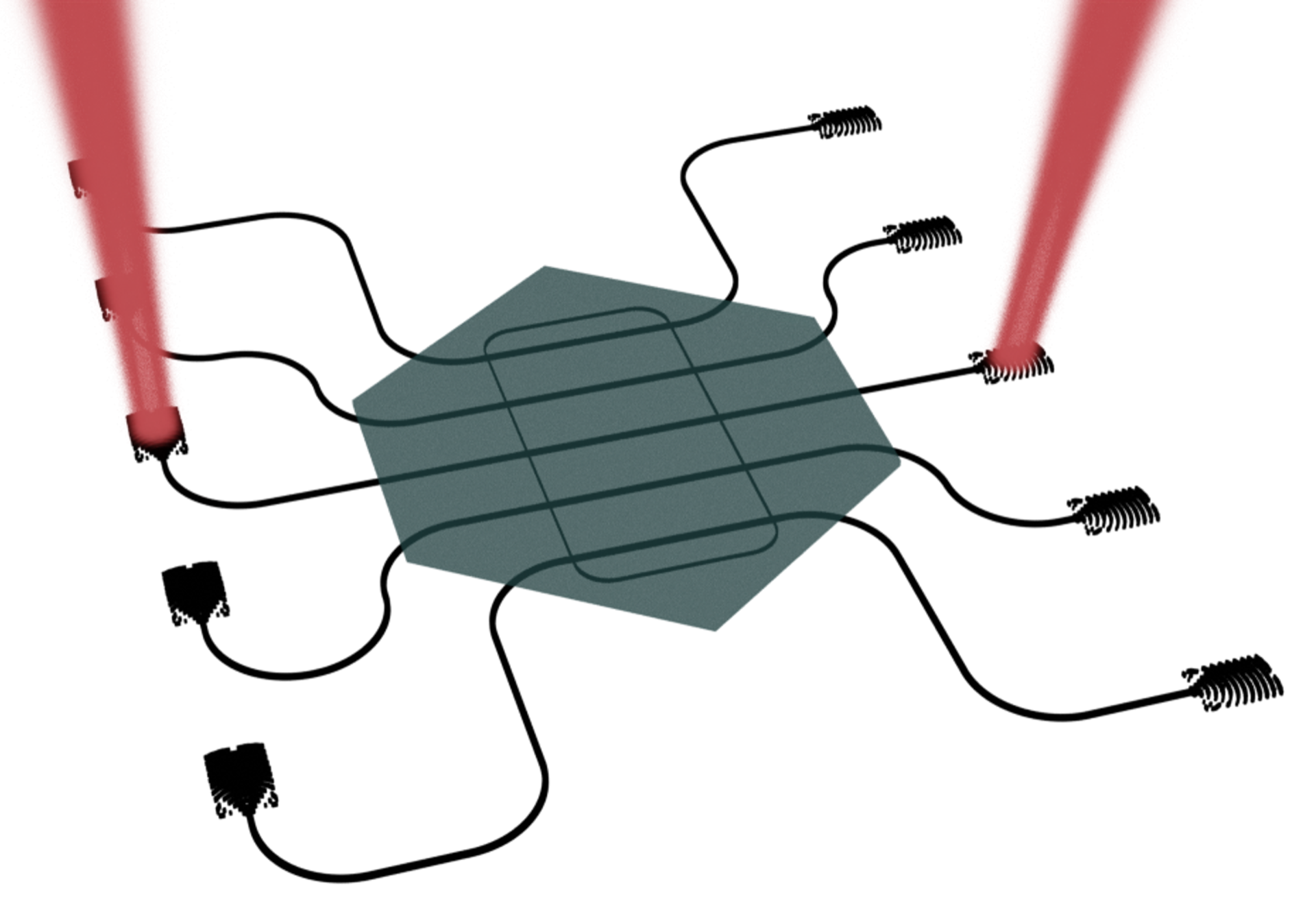
Building on these results, we have developed a hybrid molecular-nanophotonic platform that integrates organic emitters with photonic integrated circuits for on-chip cavity quantum electrodynamics and collective interactions (Lange et al., ACS Nano 2026). We are also exploring vapor-phase assembly techniques for depositing high-quality molecular emitter crystals directly onto photonic structures, opening a route to wafer-scale quantum photonic devices.
Theorydraft copy
Macroscopic QED, Green's-function methods, and cooling theory
Alongside our experiments, we develop the theoretical tools that describe how atoms and molecules interact with light in complex environments. This includes a first-order Maxwell operator formalism for macroscopic quantum electrodynamics in dispersive and absorbing media, Green's-function methods for atom-light interactions in nanophotonic structures, and a generalized theory of optical cooling for trapped atoms with spin.
Colloidal Quantum Dotsdraft copy
A new direction in bottom-up solid-state emitters
Our newest effort extends the lab's bottom-up approach to solid-state quantum emitters to colloidal quantum dots. Like our organic molecules, colloidal quantum dots are chemically synthesized emitters that can be placed into photonic structures, offering a complementary route to scalable quantum light sources. Our first paper in this direction is on its way.